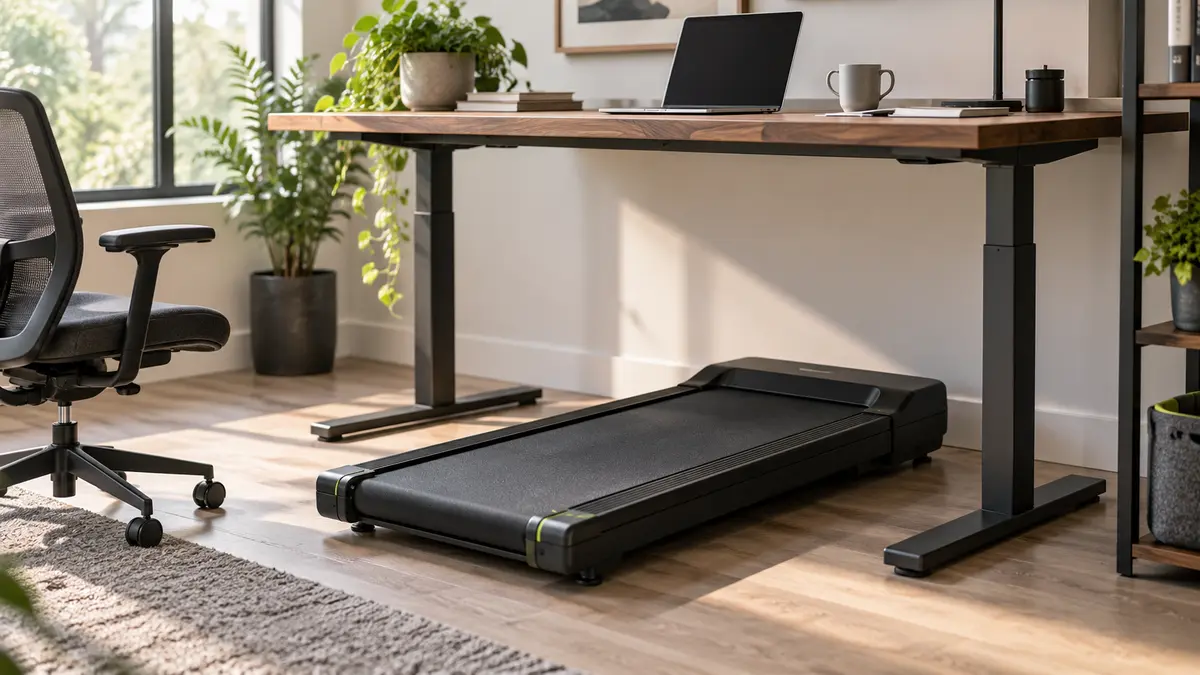
Start with the room
For this question, concentrate on the complete workstation: desk, displays, keyboard, cables, chair and treadmill. Apply the answer to the room and task you will actually use: note the desk opening, floor, interruptions and storage move before judging how to build a walking desk routine.
Create an easy transition back to the chair. If switching modes requires lifting and reorganizing the room, the walking setup is less likely to become routine. For “How to Build a Walking Desk Routine,” use that principle to turn the question into a requirement you can write down and verify.
The failure point worth catching early
The specific mistake to avoid when researching “How to Build a Walking Desk Routine” is a walking setup that makes ordinary calls or seated work difficult. This matters because a treadmill can look suitable in a product grid yet create daily friction once the chair, cord, floor and interruptions enter the picture.
A useful next step is to test one routine task, one meeting and the transition back to the chair. To resolve “How to Build a Walking Desk Routine,” check the selected model's walking-belt dimensions separately from its outside housing; the two numbers answer different questions.
A focused evaluation
- State what success would look like for “How to Build a Walking Desk Routine.”
- Identify the room measurement or operating behavior most likely to rule a model out.
- Match every specification and review to the exact product variation.
- Test the stop method, storage move and transition back to seated work.
- Read the current seller, return, warranty and maintenance information.
How to read the evidence
When researching “How to Build a Walking Desk Routine,” marketing adjectives have no shared threshold. For this decision, replace words such as compact, quiet or heavy-duty with the particular measurement, documented feature or ownership condition that would make the claim meaningful.
A review earns more weight when it names the same variation and describes a comparable room, pace and length of ownership. A first-day impression attached to a neighboring model cannot settle how to build a walking desk routine.
Decision rule
The decision is defensible when the exact model documentation supports the plan and the setup remains easy on a normal workday. Use scheduled blocks and clear stop points so walking supports the workday rather than interrupting it. If an important fact is missing, treat it as an open question rather than filling the gap with a claim from another model.